
Check your Decision Readiness Score
Use the diagnostic to see where transformation decisions may be exposed to drift, narrative risk, and value leakage.
Start the diagnosticDecision readiness before execution debt
FutureState Architects helps leaders stress-test the assumptions, ownership, governance, scope boundaries, and execution continuity behind AI, SAP, ERP, vendor-led, and transformation initiatives before approval turns into execution debt.
What breaks before execution
Assumption risk
Scope gets approved on benchmarks, case studies, vendor framing, or internal beliefs that were never tested against operating reality.
Ownership risk
Everyone agrees with the initiative, but nobody clearly owns the trade-offs once execution starts creating pressure.
Execution continuity risk
The approved scope moves into delivery without the reasoning, constraints, and decision context required to protect value.
Decision Readiness Radar
Transformation drift rarely comes from one visible failure. It usually appears as an uneven readiness profile: weak assumptions in one area, unclear ownership in another, hidden dependencies somewhere else, and scope being carried by narratives instead of traceable decisions.
Profile
Example profile: Fragile Alignment
Signal
Decision Risk: Elevated
Where to go next
Use the diagnostic to see where transformation decisions may be exposed to drift, narrative risk, and value leakage.
Start the diagnosticUse the simulator to test whether a specific scope, vendor proposal, AI initiative, SAP/ERP program, or roadmap is ready for approval.
Run the stress testStart a direct conversation about decision readiness, scope risk, advisory assessment, or Decision OS activation.
Start a conversationWhy initiatives drift
The roadmap may look aligned. The vendor proposal may look credible. The business case may look complete. But if the decision logic is weak, execution inherits hidden assumptions.
That is where AI, SAP, ERP, and transformation programs start to drift: not because people lack ambition, but because ownership, scope boundaries, governance paths, and execution context were never made explicit enough.
FSA helps leaders expose those gaps before they become rework, delayed value capture, uncontrolled scope expansion, or governance friction.
Long-term product vision
FSA is building a Decision Operating System for governed transformation: a layer that turns strategic decisions into operational objects with ownership, context, evidence, approval logic, and execution continuity.
The entry point is decision readiness. Organizations first need to see where scope, assumptions, governance, and execution continuity may break. The Decision OS becomes valuable when that operating discipline is ready to scale.
Clarify who carries a decision into execution and who has authority to revise it when reality changes.
Preserve the rationale, assumptions, constraints, and evidence behind major transformation decisions.
Keep approved scope connected to the trade-offs and decision logic that shaped it before interpretation becomes delivery risk.
What FSA can build
Beyond DTOS (Decision Transformation Operating System), FutureState Architects can design and build product experiences, implement classic or AI-applied solutions, and connect software with industrial equipment through IIoT when the work needs both a clear decision model and a delivery path.
The work starts with the decision first, then shapes the product, workflow, automation, operating rules, and physical-system integrations around it so the solution holds up in the real business environment.
Design and build product experiences, internal tools, and workflow surfaces that reflect the decision logic the company needs.
Implement software and operational solutions using conventional architecture, integrations, and delivery practices when that is the right fit.
Add AI where it improves decision support, workflow, or execution without letting the technology drive the scope.
Connect platforms to sensors, machines, and industrial systems when the decision model depends on reliable signal flow from the floor.
Industries covered
The first industries the FSA leadership team is prioritizing reflect the path it has taken through enterprise transformation in LATAM and North America. The common thread is complexity, governance, and cross-functional execution.
That keeps the site aligned with the work the team has actually done and the kinds of environments where a decision-first approach creates the most value.
Software, platforms, and product-led teams where scope, roadmap, and execution need tighter decision control.
Operational environments where process change, systems integration, IIoT, and execution continuity matter every day.
Complex regulated environments with heavy governance, program risk, and multi-stakeholder decisions.
Organizations where trust, controls, operating discipline, and change resilience are central.
Networks where logistics flows for entry, storage, and exit, planning, exceptions, handoffs, and equipment integration make decision clarity especially valuable.
Businesses that need faster execution, clearer prioritization, and better alignment across functions.
How this becomes operational
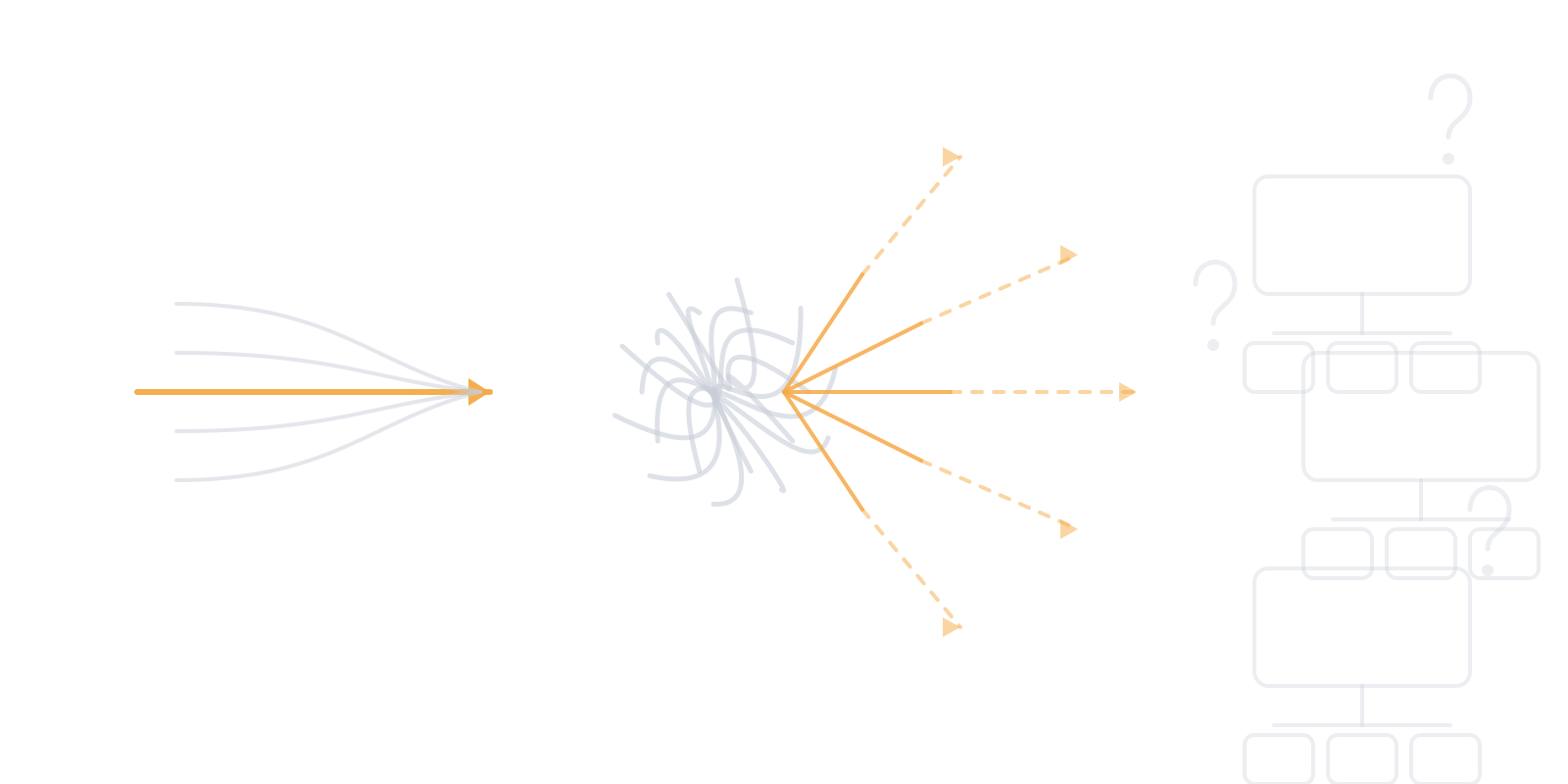
Identify where assumptions, ownership, governance, dependencies, execution continuity, or narrative risk may be weak.

Pressure-test a specific AI, SAP, ERP, vendor-led, or transformation initiative before approval turns into execution debt.

Turn findings into concrete next steps for approval, governance, scope control, or Decision OS activation.
Decision OS readiness
FutureState Architects is entering a selected-client phase. The Decision Operating System can be explored through a guided read-only demo while broader onboarding and tenant activation remain selective during early rollout.
But most organizations should not start with the product category. They should first understand whether their decision logic, scope control, governance paths, and execution continuity are ready for scale.
During this phase, FSA and approved partners may support readiness, onboarding alignment, and disciplined adoption so organizations can prepare for effective use of the Decision OS.
Advisory entry point
Not every organization is ready to activate a Decision Operating System immediately. Many first need to clarify whether a specific initiative, vendor proposal, AI roadmap, SAP/ERP program, or transformation business case is ready for approval.
FSA uses advisory as a focused entry point to diagnose decision risk, stress-test scope logic, and define the operating structure required before scale.
Diagnose
Assess where ownership, assumptions, governance, dependencies, execution continuity, and narrative risk may be weak.
Stress-test
Pressure-test a specific AI, SAP, ERP, vendor-led, or transformation initiative before the approved scope becomes execution debt.
Clarify
Turn the findings into concrete next steps for approval, governance, scope control, or Decision OS activation.
Why this company exists
The FSA leadership team is made up of people who have worked across enterprise transformation efforts in LATAM and North America and have seen the same pattern repeatedly: direction was defined, but decisions did not remain coherent as complexity grew.
That leadership experience includes future-state thinking, custom systems with and without AI, implementation and QA of ERP programs such as SAP and D365, and cloud delivery across Azure, AWS, and Google environments. FutureState Architects was created to address that problem directly by giving transformation a more durable decision layer.
What FutureState Architects is not
FSA uses advisory to clarify decision readiness and operating structure, not as the final product.
Dashboards report outcomes. They do not preserve the decisions that shape them.
AI can support reasoning, but it cannot replace decision structure, ownership, or governance.
Frameworks describe how to think. An operating system helps organizations carry decisions forward in practice.
Frequently asked questions
It is a diagnostic that helps leaders identify where transformation decisions may lose ownership, context, governance discipline, dependency visibility, execution continuity, or become dependent on narratives.
No. It does not claim to calculate exact ROI loss. It identifies where ROI leakage may be happening because decision continuity is weak.
Narrative Risk is the degree to which delivery scope depends on verbal alignment, stakeholder memory, vendor interpretation, or assumptions that are not connected to traceable decisions.
No. FSA is building the Decision Operating System. Advisory exists as a focused entry point for organizations that first need to clarify decision readiness, scope risk, and operating structure.
FSA is for executives, transformation leaders, CIOs, COOs, CFOs, and business sponsors who need strategic decisions to remain coherent across execution, governance, vendors, and scale.
Final call
Initiative drift rarely appears all at once. It shows up through weak assumptions, unclear ownership, fragmented context, hidden dependencies, narrative-driven scope, and value leakage.
Start with the Decision Readiness Score or run the Scope Stress Test before the next approval conversation. The product experience lives at futurestatearchitects.ai.